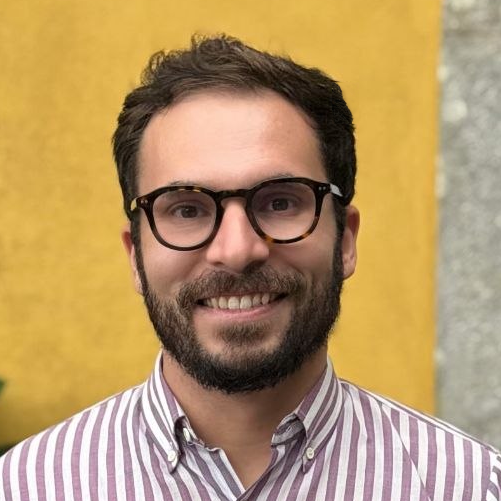
I am a tenured researcher (“chargé de recherche”) at Inria in the Cambium team in Paris.
My research focuses on proof assistants. I am interested in formalisation of models of computation and complexity, code extraction and compilation, meta-programming, type theory, and constructive and synthetic mathematics. Much of my research involves the proof assistant Rocq. I am excited about any potential collaborator for any of these topics, if you are interested in working with me please get in touch no matter your location or experience – including no or little experience!
Before joining Cambium, I was a Marie Skłodowska-Curie fellow at Inria in the Gallinette team in Nantes. And before that, I did my PhD at Saarland University with Gert Smolka.
News
- Together with Corina Cirstea, I am a PC chair of CSL ’27.
- I will be the PC chair of WITS 2027, co-located with POPL in Mexico City in January 2027.
- I will be in the PC of CPP 2027, OOPSLA 2027, and FSCD 2027.
- Accepted papers!
- “Determination of the fifth Busy Beaver value”, as part of the bbchallenge Collaboration, was accepted at STOC 2026.
- “Not choosing is still a choice – Constructive mathematics without any choice”, co-authored with Martin Baillon, Dominik Kirst, Assia Mahboubi, and Pierre-Marie Pédrot, was accepted at FSCD 2026.
- “Nested Inductive Types – Justified and Usable Nested Inductive Types in Lean and Rocq”, led by Thomas Lamiaux, was accepted at PLDI 2026, co-authored with Matthieu Sozeau and Nicolas Tabareau.
- “Code Generation via Meta-programming in Dependently Typed Proof Assistants (Experience Report)”, led by Mathis Bouverot-Dupuis, was accepted at ESOP 2026.
Older news
- I will give a talk at the (second) Logic Mentoring Workshop at FLoC 2026 in Lisbon.
- Accepted TYPES talks by Timothée Huneau (j.w.w. Dominik Kirst and Sam van Gool), Dominik Kirst, Eske Nielsen and Jessica Allegro (both j.w.w. many people).
- In October 2025
- Mathis Bouverot-Dupuis is starting his PhD on guarantees for meta-programming, co-supervised by François Pottier.
- Timothée Huneau is starting his PhD on constructive and classical reverse mathematics related to model theory, co-supervised by Dominik Kirst and Sam van Gool.
- Sara Rousta is starting her Master’s thesis on realisability in synthetic computability, co-supervised by Dominik Kirst.
- Jean Caspar is starting a 4 months internship on continuity properties for partial functions in constructive mathematics.
- I was in the PC of ITP ’26.
- Together with Chantal Keller, I am a PC chair of ITP ’25.
- I gave an invited talk at LFMTP ’25 on obtaining executable programs from dependently typed proof assistants.
- I am in the PC of CICM ’25.
- From April to August, Simon Dima will do an internship with me on extraction of programs from proof assistants, and Timothée Huneau on a Rocq proof on the Downward Löwenheim Skolen theorem for arbitrary cardinalities, co-supervised by Dominik Kirst.
- In June and July, Hugo Segoufin-Chollet will do an internship on defining the semantics of a sublanguage of CakeML in Rocq.
- I’m very proud of my students who got abstracts accepted at TYPES
’25:
- Janis Bailitis on Löb’s Theorem and Provability Predicates in Rocq (joint work with Dominik Kirst),
- Mathis Bouverot-Dupuis on Code Generation via Meta-programming in Dependently Typed Proof Assistants (Experience Report), and
- Yee-Jian Tan on Towards Formalising the Guard Checker of Rocq.
- I am an invited speaker at CSL ’25 in Amsterdam in February.
- I am an invited speaker at the Simons Institute for the Theory of Computing and SLMath Joint Workshop: AI for Mathematics and Theoretical Computer Science in Berkeley in April
- I was in the PC of PLDI ’25.
- The 5-th busy beaver number is 47,176,870. I reviewed the Coq proof and can confirm that it proves what it claims to prove. This Quanta Magazine article has the full story, and this Le Monde article has a shorter story in French.
- From September to November, I will be teaching the course on proof assistants in the Parisian Master of Research in Computer Science (MPRI) together with Théo Winterhalter.
- Thomas Lamiaux started his PhD in September in Nantes, and will work with Nicolas Tabareau, Matthieu Sozeau, and me on Coq’s guard condition.
- Mathis Bouverot-Dupuis will do a 5 months long internship with me, working on meta-programming in proof assistants based on dependent type theory.
- From May to August, I had two interns working on the MetaCoq project: Yee-Jian Tan, working on a reimplementation and specification of Coq’s guard condition, and Weituo Dai, working on scope guarantees for meta-programs.
- I am workshop co-chair of ICFP ’24 together with Chandra Nandi.
- I gave an invited talk on Synthetic Computability without Choice at the Panhellenic Logic Symposium in Thessaloniki, reporting on joint work with Dominik Kirst, Gert Smolka, Felix Jahn, Niklas Mück, and Haoyi Zeng.
- Our paper Separating Markov’s Principles, joint work with Liron Cohen, Dominik Kirst, Bruno da Rocha Paiva, and Vincent Rahli, got accepted at LICS ’24.
- Our paper Verified Extraction from Coq to OCaml, joint work with Matthieu Sozeau and Nicolas Tabareau, got accepted at PLDI ’24 and was chosen as a distinguished paper!
- I will attend TYPES ’24. Lots of interesting talks in session 4!
- Our paper The Kleene-Post and Post’s Theorem in the Calculus of Inductive Constructions with Dominik Kirst and Niklas Mück was accepted at CSL ’24 (pre-print).
- We ran a tutorial on MetaCoq at POPL, on Sunday, January 14th, with Meven Lennon-Bertrand, Matthieu Sozeau, and Théo Winterhalter.
- As of December 1st, I joined the Cambium team at Inria Paris on a permanent position.
- From September to November I taught the course on proof assistants in the Parisian Master of Research in Computer Science (MPRI) together with Théo Winterhalter.
- Our paper Oracle Computability and Turing Reducibility in the Calculus of Inductive Constructions with Dominik Kirst and Niklas Mück was accepted at APLAS ’23.
- New pre-print on hal: Correct and Complete Type Checking and Certified Erasure for Coq, in Coq, with Matthieu Sozeau, Meven Lennon-Bertrand, Jakob Botsch Nielsen, Nicolas Tabareau, and Théo Winterhalter.
- I gave 3 lectures on Coq, MetaCoq, and (verified) extraction at the Proof and Computation 2023 autumn school in Herrsching near Munich in September. Slides for lecture 1 on Coq, lecture 2 on MetaCoq, lecture 3 on verified extraction.
- I will attend ICFP 2023 in Seattle where I served as workshop co-chair with Arthur Azevedo de Amorim.
- I gave a talk on Synthetic Computability in Constructive Type Theory in the special session on proof assistants at CALCO & MFPS 2023 in Bloomington, Indiana.
- I was an invited speaker at TYPES 2023 in Valencia and gave a talk about verified extraction from Coq to OCaml.
- At TYPES, I also gave a talk on Markov’s Principles in Constructive Type Theory, joint work with Dominik Kirst, Bruno da Rocha Paiva, and Vincent Rahli.
- Our paper A Computational Cantor-Bernstein and Myhill’s Isomorphism Theorem in Constructive Type Theory with Felix Jahn and Gert Smolka was accepted at CPP 2023. Pre-print on hal.
- Our paper Constructive and Synthetic Reducibility Degrees: Post’s Problem for Many-one and Truth-table Reducibility in Coq with Felix Jahn was accepted at CSL 2023. Pre-print on hal.
- The TYPES conference in
Nantes has lots of interesting talks! I was involved in several:
- On Tuesday, Tiago Cogumbreiro will present our work Towards a Mechanized Theory of Computation for Education.
- Immediately afterwards, Felix Jahn will talk about our joint work with Gert Smolka, Myhill Isomorphism Theorem and a Computational Cantor-Bernstein Theorem in Constructive Type Theory.
- Then I’ll give a talk on Synthetic Turing Reducibility in CIC, joint work with Dominik Kirst.
- On Wednesday, I’ll be talking about Aspects of a machine-checked intermediate language for extraction from Coq, in MetaCoq, joint work with Matthieu Sozeau.
- And on Thursday, Dominik Kirst will talk about our Synthetic Versions of the Kleene-Post and Post’s Theorem, joint work with Niklas Mück.
- Our paper Synthetic Kolmogorov Complexity in Coq with Fabian Kunze and Nils Lauermann got accepted at ITP ’22!
- Two new pre-prints out! With Felix Jahn and Gert Smolka: A Constructive and Synthetic Theory of Reducibility: Myhill’s Isomorphism Theorem and Post’s Problem for Many-one and Truth-table Reducibility in Coq. With Fabian Kunze and Nils Lauermann: Synthetic Kolmogorov Complexity in Coq.
- My paper Parametric Church’s Thesis: Synthetic Computability without Choice got accepted at LFSC ’22 and won the Rosser Prize. LFCS has free online participation!
Current Students
Arthur Adjedj, PhD student, co-supervised with Nicolas Tabareau. From October 2026.
Yoshimi-Theophile Etienne, PhD student, co-supervised with Théo Winterhalter. From October 2026.
Martin Trucchi, PhD student, co-supervised with Dominik Kirst and Lutz Straßburger. From October 2026.
Timothée Huneau, PhD student, co-supervised with Dominik Kirst and Sam van Gool. From October 2025.
Mathis Bouverot-Dupuis, PhD student, co-supervised with François Pottier. From September 2025.
Thomas Lamiaux, PhD student, co-supervised with Nicolas Tabareau and Matthieu Sozeau. From September 2024.
Publications
Pre-prints
-
Haoyi Zeng, Yannick Forster, Dominik Kirst, and Takako Nemoto.
Post's Problem in Constructive Mathematics,
pre-print.

Conferences
-
The bbchallenge Collaboration.
Determination of the fifth Busy Beaver value,
STOC 2026.
-
Martin Baillon, Yannick Forster, Dominik Kirst, Assia Mahboubi, and Pierre-Marie Pédrot.
Not choosing is still a choice – Constructive mathematics without any choice,
FSCD 2026.
-
Thomas Lamiaux, Yannick Forster, Matthieu Sozeau, and Nicolas Tabareau.
Nested Inductive Types – Justified and Usable Nested Inductive Types in Lean and Rocq,
PLDI 2026.
-
Mathis Bouverot-Dupuis and Yannick Forster.
Code Generation via Meta-programming in Dependently Typed Proof Assistants,
ESOP 2026.
-
Martin Baillon, Yannick Forster, Assia Mahboubi, Pierre-Marie Pédrot, Matthieu Piquerez.
A Zoo of Continuity Properties in Constructive Type Theory,
FSCD 2025.
-
Liron Cohen, Yannick Forster, Dominik Kirst, Bruno da Rocha Paiva, and Vincent Rahli.
Separating Markov's Principles,
LICS 2024.
-
Yannick Forster, Matthieu Sozeau, and Nicolas Tabareau.
Verified Extraction from Coq to OCaml,
PLDI 2024.
-
Yannick Forster, Dominik Kirst, and Niklas Mück.
The Kleene-Post and Post’s Theorem in the Calculus of Inductive Constructions,
CSL 2024.

-
Yannick Forster, Dominik Kirst, and Niklas Mück.
Oracle Computability and Turing Reducibility in the Calculus of Inductive Constructions,
APLAS 2023.
-
Yannick Forster, Felix Jahn, and Gert Smolka.
A Computational Cantor-Bernstein and Myhill’s Isomorphism Theorem in Constructive Type Theory,
CPP 2023.
-
Yannick Forster and Felix Jahn.
Constructive and Synthetic Reducibility Degrees: Post’s Problem for Many-One and Truth-Table Reducibility in Coq,
CSL 2023.
-
Yannick Forster, Fabian Kunze, and Nils Lauermann.
Synthetic Kolmogorov Complexity in Coq,
ITP 2022.
-
Yannick Forster, 2022.
Parametric Church’s Thesis: Synthetic Computability Without Choice,
LFCS 2022.
-
Yannick Forster, Fabian Kunze, Gert Smolka, and Maxi Wuttke.
A Mechanised Proof of the Time Invariance Thesis for the Weak Call-By-Value λ-Calculus,
ITP 2021.
-
Yannick Forster.
Church’s Thesis and Related Axioms in Coq’s Type Theory,
CSL 2021.
(talk)
-
Matthieu Sozeau, Simon Boulier, Yannick Forster, Nicolas Tabareau, and Théo Winterhalter.
Coq Coq Correct! verification of type checking and erasure for Coq, in Coq, POPL 2020.
-
Yannick Forster, Fabian Kunze, and Marc Roth.
The weak call-by-value λ-calculus is reasonable for both time and space,
POPL 2020.
-
Yannick Forster, Fabian Kunze, and Maxi Wuttke.
Verified programming of Turing machines in Coq,
CPP 2020.
-
Simon Spies and Yannick Forster.
Undecidability of higher-order unification formalised in Coq,
CPP 2020.
-
Yannick Forster and Kathrin Stark.
Coq à la carte: a practical approach to modular syntax with binders,
CPP 2020.
-
Yannick Forster, Dominik Kirst, and Dominik Wehr.
Completeness Theorems for First-Order Logic Analysed in Constructive Type Theory,
LFCS 2020.
-
Yannick Forster and Fabian Kunze.
A Certifying Extraction with Time Bounds from Coq to Call-By-Value Lambda Calculus,
ITP 2019.
-
Dominique Larchey-Wendling and Yannick Forster.
Hilbert’s Tenth Problem in Coq,
FSCD 2019.
-
Yannick Forster, Dominik Kirst, and Gert Smolka.
On synthetic undecidability in Coq, with an application to the Entscheidungsproblem,
CPP 2019.
-
Yannick Forster and Dominique Larchey-Wendling.
Certified undecidability of intuitionistic linear logic via binary stack machines and Minsky machines,
CPP 2019.
-
Yannick Forster, Steven Schäfer, Simon Spies, and Kathrin Stark.
Call-by-push-value in Coq: operational, equational, and denotational theory,
CPP 2019.
-
Fabian Kunze, Gert Smolka, and Yannick Forster.
Formal Small-Step Verification of a Call-by-Value Lambda Calculus Machine,
APLAS 2018.
-
Yannick Forster, Edith Heiter, and Gert Smolka.
Verification of PCP-Related Computational Reductions in Coq,
ITP 2018.
-
Yannick Forster, Ohad Kammar, Sam Lindley, and Matija Pretnar.
On the expressive power of user-defined effects: effect handlers, monadic reflection, delimited control,
ICFP 2017.
-
Yannick Forster and Gert Smolka.
Weak Call-by-Value Lambda Calculus as a Model of Computation in Coq,
ITP 2017.
Journals
-
Matthieu Sozeau, Yannick Forster, Meven Lennon-Bertrand, Jakob Botsch Nielsen, Nicolas Tabareau, and Théo Winterhalter. Correct and Complete Type Checking and Certified Erasure for Coq, in Coq, Journal of the ACM.
-
Yannick Forster, Dominik Kirst, and Dominik Wehr. Completeness theorems for first-order logic analysed in constructive
type theory (extended version), J. Log. Comput. , volume 31, number 1, pp. 112–151.
-
Matthieu Sozeau, Abhishek Anand, Simon Boulier, Cyril Cohen, Yannick Forster, Fabian Kunze, Gregory Malecha, Nicolas Tabareau, and Théo Winterhalter.
The MetaCoq Project, J. Autom. Reason., volume 64, number 5, pp. 947–999.
-
Dominique Larchey-Wendling and Yannick Forster.
Hilbert’s Tenth Problem in Coq (extended version),
LMCS, Volume 18, Issue 1.
-
Yannick Forster and Gert Smolka.
Call-by-Value Lambda Calculus as a Model of Computation in Coq, J. Autom. Reason., volume 63, number 2, pp. 393–413.
- Yannick Forster, Ohad Kammar, Sam Lindley, and Matija Pretnar. On the expressive power of user-defined effects: Effect handlers, monadic reflection, delimited control, J. Funct. Program., volume 29, p. e15.
Extended Workshop Abstracts
Exploring blurred choice axioms for constructive reverse mathematics
Timothée Huneau, Yannick Forster, Dominik Kirst, Sam van Gool
TYPES ’26, Gothenburg, Sweden, 2026Constructive Mathematics without any choice
Yannick Forster, Dominik Kirst
TYPES ’26, Gothenburg, Sweden, 2026Peregrine: a middle-end for code generation from proof assistants
Eske Hoy Nielsen, Simon Dima, Lucas Escot, Orestis Melkonian, Hugo Segoufin-Cholet, James Chapman, Yannick Forster, Matthieu Sozeau, Bas Spitters
TYPES ’26, Gothenburg, Sweden, 2026On the logical structure of choice, bar induction, maximality and well-foundedness principles equivalent to the axiom of choice
Jessica Allegro, Martin Baillon, Nuria Brede, Hugo Herbelin, Yannick Forster, Jad Koleilat, Étienne Miquey, Dimitar Mitov
TYPES ’26, Gothenburg, Sweden, 2026Towards Formalising the Guard Checker of Rocq
Yee-Jian Tan, Yannick Forster
TYPES ’25, Glasgow, Scotland, 2025Code Generation via Meta-programming in Dependently Typed Proof Assistants (Experience Report)
Mathis Bouverot-Dupuis, Yannick Forster
TYPES ’25, Glasgow, Scotland, 2025Löb’s Theorem and Provability Predicates in Rocq
Janis Bailitis, Dominik Kirst, Yannick Forster
TYPES ’25, Glasgow, Scotland, 2025Post’s Problem in Constructive Mathematics
Haoyi Zeng, Yannick Forster, Dominik Kirst, Takako Nemoto
CCC ’24, Nice, France, 2024A zoo of continuity properties in constructive type theory
Martin Baillon, Yannick Forster, Assia Mahboubi, Pierre-Marie Pédrot, Matthieu Piquerez
CCC ’24, Nice, France, 2024A zoo of continuity properties in constructive type theory
Martin Baillon, Yannick Forster, Assia Mahboubi, Pierre-Marie Pédrot, Matthieu Piquerez
TYPES ’24, Copenhagen, Denmark, 2024Limited Principles of Omniscience in Constructive Type Theory
Bruno da Rocha Paiva, Liron Cohen, Yannick Forster, Dominik Kirst, Vincent Rahli
TYPES ’24, Copenhagen, Denmark, 2024Post’s Problem and the Priority Method in CIC
Haoyi Zeng, Yannick Forster, Dominik Kirst
TYPES ’24, Copenhagen, Denmark, 2024Markov’s Principles in Constructive Type Theory
Yannick Forster, Dominik Kirst, Bruno da Rocha Paiva, Vincent Rahli
TYPES ’23, Valencia, Spain, 2023Extraction to OCaml from Coq: Operational Correctness Verified in Coq
Yannick Forster, Matthieu Sozeau, Pierre Giraud, Pierre-Marie Pédrot, Nicolas Tabareau
ML Family Workshop, Ljubljana, Slovenia, 2022.Towards a Mechanized Theory of Computation for Education
Tiago Cogumbreiro, Yannick Forster
TYPES 2022, Nantes, France, 2022.Myhill’s Isomorphism Theorem and a Computational Cantor-Bernstein Theorem in Constructive Type Theory
Yannick Forster, Felix Jahn, Gert Smolka
TYPES 2022, Nantes, France, 2022.Synthetic Turing Reducibility in CIC
Yannick Forster, Dominik Kirst
TYPES 2022, Nantes, France, 2022.Aspects of a machine-checked intermediate language for extraction from Coq, in MetaCoq
Yannick Forster, Matthieu Sozeau
TYPES 2022, Nantes, France, 2022.Synthetic Versions of the Kleene-Post and Post’s Theorem
Dominik Kirst, Niklas Mück, Yannick Forster
TYPES 2022, Nantes, France, 2022.The curious case of case: correct & efficient representation of case analysis in Coq and MetaCoq
Matthieu Sozeau, Meven Lennon-Bertrand, Yannick Forster
The first Workshop on the Implementation of Type Systems (WITS). Philadelphia, Pennsylvania, United States / online, 2022.Generating induction principles and subterm relations for inductive types using MetaCoq (slides)
Bohdan Liesnikov, Marcel Ullrich, Yannick Forster
Coq Workshop 2020, online, 2020.Towards Extraction of Continuity Moduli in Coq (pdf) (slides)
Yannick Forster, Dominik Kirst, Florian Steinberg
Types 2020, Turin, Italy, 2020.A Coq Library of Undecidable Problems (slides) (talk recording)
Yannick Forster, Dominique Larchey-Wendling, Andrej Dudenhefner, Edith Heiter, Dominik Kirst, Fabian Kunze, Gert Smolka, Simon Spies, Dominik Wehr, Maxi Wuttke
CoqPL 2020, New Orleans, USA, 2020.Coq Coq Codet! - Towards a Verified Toolchain for Coq in MetaCoq (slides)
Matthieu Sozeau, Yannick Forster, Simon Boulier, Nicolas Tabareau and Théo Winterhalter
Coq Workshop 2019, Portland, USA, 2019.Mechanically verified type and proof erasure for Coq
Yannick Forster and Matthieu Sozeau
Facets of Realizability 2019, Paris, France, 2019.A constructive Coq library for the mechanization of undecidability (slides)
Yannick Forster and Dominique Larchey-Wendling
MLA 2019, Nancy, France, 2019.xTowards a library of formalised undecidable problems in Coq: The undecidability of intuitionistic linear logic (slides)
Yannick Forster and Dominique Larchey-Wendling
LOLA 2018, Oxford, UK, 2018.The strong invariance thesis for a lambda-calculus (slides)
Yannick Forster, Fabian Kunze, Marc Roth
LOLA 2017, Reykjavik, Iceland, 2017.Verified Extraction from Coq to a Lambda-Calculus (slides)
Yannick Forster and Fabian Kunze
Coq Workshop 2016, ITP 2016, Nancy, France, 2016.
Theses
Computability in
Constructive Type Theory
PhD thesis, Saarland University,
2021.
On the
expressive power of effect handlers and monadic reflection (pdf)
Master’s Thesis, Robinson College, University of Cambridge,
2016.
A
Formal and Constructive Theory of Computation (pdf)
Bachelor’s Thesis, Programming Systems Lab, Saarland
University, 2014.
Talks
Talks since December 2021, for older talks see my old website.
Using proof assistants as more than checkers, and how to write papers about it
Talk at the logic mentoring workshop at FLoC ’26.
Talk at the Research Seminar on Formal Mathematics, Heidelberg UniversityObtaining executable programs from dependently typed proof assistants
Invited talk at LFCS ’25.** Synthetic Mathematics for the Mechanisation of Computability Theory and Logic**
Invited talk at CSL ’25.Synthetic Computability without Choice
Invited talk at the 14th Panhellenic Logic Symposium.A zoo of continuity properties in constructive type theory
Talks at TYPES 2024.
Joint work with Martin Baillon, Assia Mahboubi, Pierre-Marie Pédrot, Matthieu Piquerez.Synthetic Computability in Constructive Type Theory
Invited talk in the special session on proof assistants at CALCO & MFPS 2023
Bloomington, Indiana.Verified Extraction from Coq to OCaml
Invited talk at TYPES 2023.
Joint work with Matthieu Sozeau, Pierre-Marie Pédrot, and Nicolas Tabareau.Synthetic Computability in Constructive Type Theory.
Talk at the Chocola meeting. June 2nd 2022, Lyon.
Joint work with joint with Dominik Kirst, Gert Smolka, Felix Jahn, Niklas Mück, Nils Lauermann, Fabian Kunze, and the contributors of the Coq Library of Undecidability Proofs.Towards verified extraction from Coq to Ocaml.
Talk at the Journée scientifique Inria - Nomadic Labs, June 1st 2022, Paris.
Joint work with Matthieu Sozeau, Pierre Giraud, Pierre-Marie Pédrot, and Nicolas Tabareau.Verified Extraction to OCaml from Coq, in Coq
Invited Talk at the Conference on Algorithmic Law Design and Implementation. April 28th 2022, Barcelona.
Joint work with Matthieu Sozeau, Pierre Giraud, Pierre-Marie Pédrot, and Nicolas Tabareau.
Teaching
Supervised students
Simon Dima, 2025, MPRI M2 internshop Extraction from Lean to Rocq
Timothée Huneau, 2025, Lyon 1 M2 internship, co-supervised by Dominik Kirst. A Rocq proof on the Downward Löwenheim Skolen theorem for arbitrary cardinalities.
Hugo Segoufin-Chollet, 2025, ENS Lyon L3 internship Semantics of CakeML in Rocq
Yee Jian Tan, 2024, MPRI M1 internship
A specification of Coq’s guard condition in MetaCoq.Weituo Dai, 2024, MPRI M2 internship
Meta-programming with guarantees in MetaCoq.Haoyi Zeng, 2023, Bachelor’s thesis, co-advised with Dominik Kirst
Post’s problem and the priority method in the Calculus of Inductive Constructions.Janis Bailitis, 2024, Bachelor’s thesis, co-advised with Dominik Kirst
Löb’s theorem in Coq.Fabian Brenner, 2024, Bachelor’s thesis, co-advised with Dominik Kirst
The undecidability of finitary PCF in Coq.Niklas Mück, 2021, Bachelor’s thesis, co-advised with Dominik Kirst
The Arithmetical Hierarchy and Post’s Theorem in Coq.Roberto Álvarez, 2021, Master’s thesis
Mechanized undecidability of subtyping in System F.Felix Jahn, 2020, Bachelor’s thesis
Synthetic One-One, Many-One, and Truth-Table Reducibility in Coq.Marcel Ullrich, 2020, Bachelor’s thesis
Generating induction principles for nested inductive types in MetaCoq.Dominik Wehr, 2019, Bachelor’s thesis, co-advised with Dominik Kirst
A Constructive Analysis of First-Order Completeness Theorems in Coq.Simon Spies, 2019, Bachelor’s thesis
Formalising the Undecidability of Higher-Order Unification.Maxi Wuttke, 2018, Bachelor’s thesis
Verified Programming Of Turing Machines In Coq.Edith Heiter, 2017, Bachelor’s thesis, co-advised with Gert Smolka
Undecidability of the Post Correspondence Problem in Coq.
Lectures
- Winter 2025: Proof assistants, M2 course, Parisian Master in Research in Computer Science (MPRI), with Théo Winterhalter.
- Winter 2024: Proof assistants, M2 course, Parisian Master in Research in Computer Science (MPRI), with Théo Winterhalter.
- Winter 2023: Proof assistants, M2 course, Parisian Master in Research in Computer Science (MPRI), with Théo Winterhalter.
- Winter 2022/2023: Proof assistants, M2 course, Parisian Master in Research in Computer Science (MPRI), with Matthieu Sozeau and Théo Winterhalter.
- Winter 2020/2021: Advanced Coq Programming, Block course, Programming Systems Lab.
- Winter 2018/2019: Programming 1, Basic course, Programming Systems Lab.
- Summer 2018: Advanced Coq Programming, Block course, Programming Systems Lab.
- Winter 2017: Category Theory, Seminar, Programming Systems Lab.
- Summer 2017: Mathematics Precourse, Saarland University.
- Summer 2017: Didactic Seminar for Student TAs in Programming 1, Reactive Systems Group.
Short CV
- since 2023: Permanent researcher (“chargé de recherche”) in the Cambium team at Inria Paris.
- 2021-2023: Postdoctoral Marie Skłodowska-Curie Fellow in the Gallinette team at Inria Nantes
- 2021: PhD in the group of Gert Smolka at Saarland University
- 2016: MPhil in advanced computer science at the University of Cambridge, with distinction
- 2015: B. Sc. in computer science at Saarland University
Click here for a full but only occasionally updated CV.